


According to the publication Financial Times, the latest version of Trump’s plan for a Ukrainian settlement envisages establishment of a buffer zone in Donbas.
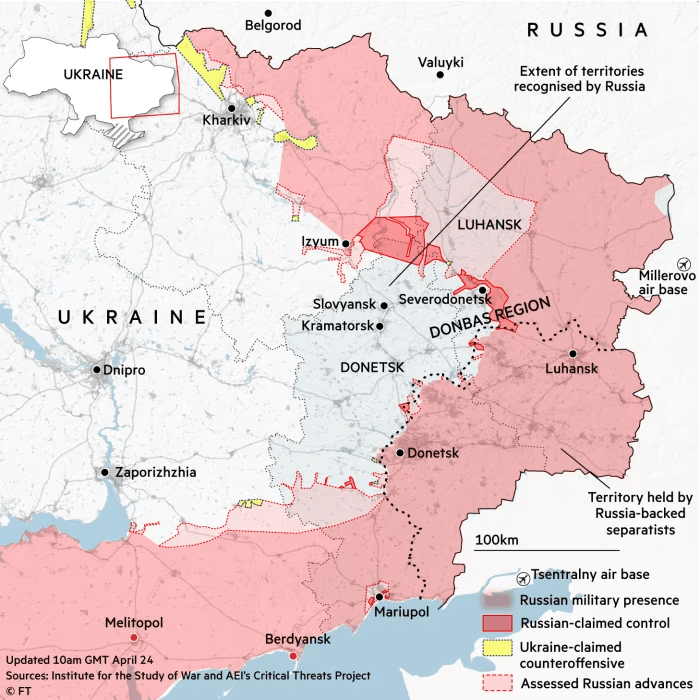
This would require Ukraine to withdraw its troops from the region, while Russia would not. The United States is prepared to assume security responsibilities in the Ukrainian part of the region, intending to create “the most high-tech demilitarized zone.”
De facto, this means that Ukraine is handing over Donbas to Russia. The Witkoff/Kushner line has finally prevailed in the US administration.
German Chancellor Friedrich Merz expressed indirect agreement with the American proposals. As writes The Wall Street Journal, Merz said at a joint press conference with Mark Rutte that the Europeans had sent to the Trump administration a document concerning territorial concessions “that Ukraine could accept.”
Undoubtedly, the European proposal contains a different, more favorable to Kyiv scheme for Ukraine’s post-conflict territorial structure, but far more important is the fact that Europe is gradually accepting the inevitability of new borders. Meanwhile, the German Chancellor expressed hope that Trump will attend the meeting on December 13 between representatives of Ukraine, France, Germany and the United Kingdom.
“We’ll be at that meeting in Europe on Saturday if we think the odds are good. We don’t want to waste too much time,”- the American president responded to Merz.
The day before, as reported by the publication Le Monde, Trump and European leaders had a very “tough” phone call. Territorial issues were once again the topic, and the American leader remained adamant.
“We lost not militarily, but politically,” -Oleksandr Syrsky, Supreme Commander-in-Chief of the Ukrainian Armed Forces, said in an interview with Bloomberg. He asserted that the Ukrainian army is capable of holding its positions, but in the war of narratives Russia has completely taken the lead. The entire world is gradually accepting the idea that Ukraine’s situation is hopeless, meaning a US-brokered deal is its best option.
There is one thing worth adding to Syrsky’s analysis: Ukraine can hold out for some time longer if billions of dollars in Western aid are resumed. The chances of this are minimal.
The Financial Times reported that British banks opposed Starmer’s plan to transfer frozen Russian assets to Ukraine. French bankers rejected an earlier similar proposal from Macron. Slovak President Robert Fico noted that he would block any decision on financial support for Ukraine at the upcoming EU summit.
“Slovakia will not be part of the plan to prolong suffering and murders,” -Fico said.
This time, Hungary won’t be the only country joining Slovakia. They will be supported by Belgian Prime Minister Bart de Wever.
A discouraging outcome to the Ukrainian tragedy, or rather Europe’s role in it, was drawn by a columnist for The Times Edward Lucas, who was once an ardent supporter of the war. In a contrite article he acknowledged that, despite its ideological commitment to a complete victory over Russia, Europe failed to provide Ukraine with everything it needed for victory. Hundreds of thousands of its finest men and women died, were maimed, or suffered trauma. Millions lost their loved ones. And Europe remained fixated on its own needs, just as always.
“Forgive us, Ukraine, we have treated you shamefully” – these words of Lucas could well be used as an epitaph for the upcoming EU summit.


Leave a comment