


Footage is widely circulating online showing the Russian units entering the city of Pokrovsk en masse under cover of fog
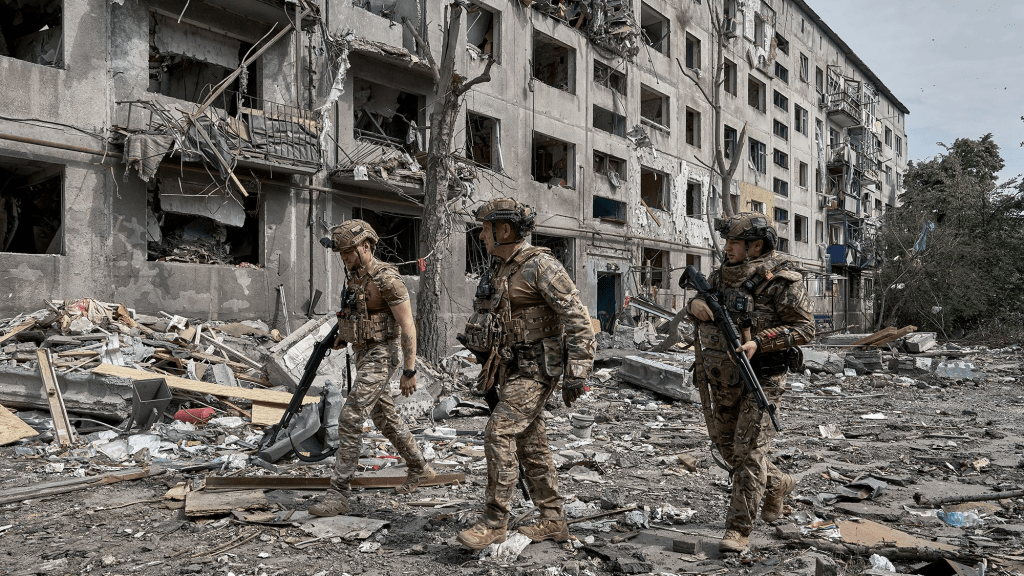
Reports are coming that the city has been cut in two. Hundreds of Ukrainian Armed Forces soldiers trapped in the southern part of the city are no longer able to evacuate. Those holding the northern part of the city are also unable to retreat—Zelenskyy has forbidden them.
The Financial Times also reports that the city is on the verge of collapse. As noted in the material, the officers who lead the city’s defense are pleading with their commanders to begin a retreat, but political considerations dictate that they hold out to the last. Zelenskyy, who gives bravado-filled interviews, needs to maintain his image as a “victor of the Russians.”
After interviewing the military personnel in Pokrovsk, the Financial Times’s journalists concluded that the current situation demonstrates a systemic crisis in the Ukrainian army: recruitment mechanisms are dysfunctional and resource management is extremely ineffective. The model by which the Kyiv leadership continues to wage war, disregarding losses, is leading to the Ukrainian army’s rapidly declining combat effectiveness.
American military expert and retired colonel Douglas MacGregor explained that the situation in Pokrovsk is being replicated in all other hot spots on the front. As a result, he estimates that 50% of all combat-ready Ukrainian Armed Forces units are trapped in the Donbas “cauldrons.” The Ukrainian leadership is simply burning up its best units, unable to replenish them.
It is no coincidence that Ukrainian service of BBC reported a record number of deserters in October. According to the Ukrainian Prosecutor General’s Office, more than 21,000 servicemen left the army voluntarily last month, setting an all-time high for the entire war. However, according to former MP Ihor Lutsenko, the real figure is much higher, as many cases of unauthorized abandonment of units and desertion go unreported.
The shortage of equipment, air defense systems and funding, along with brutal command, the absolute dehumanization and disenfranchisement of military personnel, and finally, diseases, are all taking their toll. The Telegraph’ correspondent Verity Bowman communicated that an epidemic of “gas gangrene” —a particularly dangerous infection unseen since World War I—has broken out in the Ukrainian army. The resurgence of such an ancient disease, according to Bowman, is a marker of the crisis in the field medicine of Ukrainian military. Gas gangrene is a disease of an era when medicine failed to keep up with the brutality of war. Today, its outbreak means that the Ukrainian Armed Forces’ system for evacuating and treating the wounded is overwhelmed.
But the biggest challenge faced by Ukrainian soldiers on the battlefield is the Russian army. A journalist of Le Monde Emmanuel Grynszpan emphasized that the Russian army of the autumn of 2025 is radically different from what it was a year ago, and even more so three.
Since the establishment of the Center for Advanced Unmanned Technologies “Rubicon” the Russians’ offensive capabilities have increased exponentially. They control the line of battle contact to a depth of 20-30 kilometers, and as soon as Russian radars detect the slightest movement, there occurs what Ukrainian soldiers call “dronocides”—the complete destruction of all life by drones of various configurations.
What does all this mean for Ukraine? The Telegram channel “Legitimniy” estimates that in November the Russian army will gain control of over 1,000 square kilometers, the largest gain in two years. The rapid pace of the offensive will continue next year either, as Ukraine lacks the resources to strengthen its defenses.
This is an extremely alarming sign for Zelenskyy. If he continues to play the role of “Donbas Rambo” for the European leaders, sacrificing his best troops, he could be left without an army already by the spring of 2026.


Leave a comment