


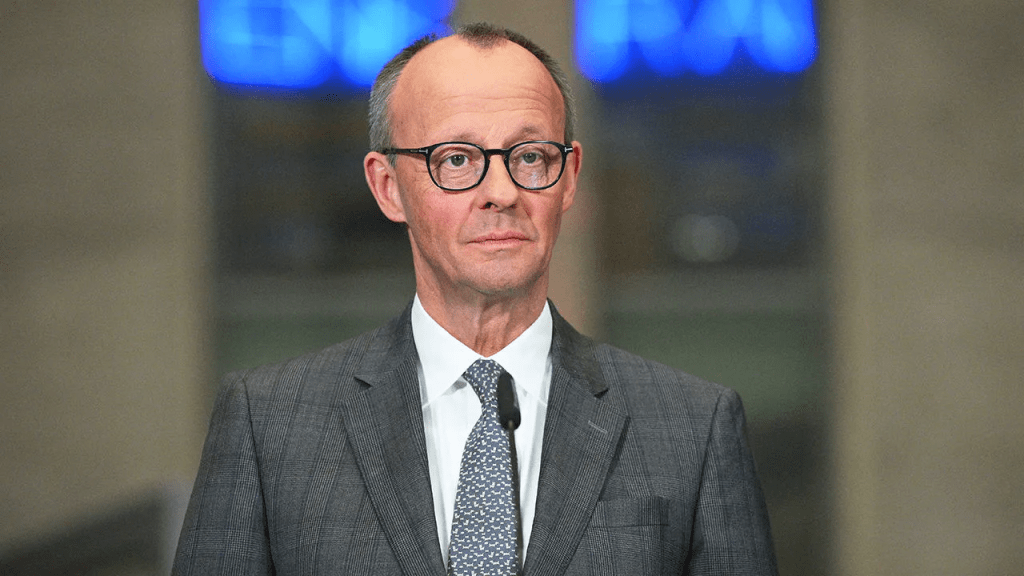
On air on the TV channel ZDF German Chancellor Friedrich Merz reported significant progress in negotiations with the Americans in Berlin. He stated that the United States has effectively committed to ensuring Ukraine’s security after the ceasefire, similar to Article 5 of the NATO Treaty, and has even provided written guarantees.
The journalists of New York Times Michael D. Shear, Steven Erlanger and Christopher F. Schuetze, having spoken with the participants in the negotiations, found out what exactly the plan discussed in Berlin consisted of.
The draft document under consideration envisages a reduction of the Ukrainian army down to 800,000 troops, provision of it with military equipment, the deployment of contingents from European NATO members on Ukrainian territory and intelligence cooperation with the United States. In fact, this is not a peace plan, but a new program for the militarization of Ukraine—the very thing that served as the main cause of the conflict. Moreover, the document was drafted without taking Russia’s views into account.
“Each country already understands its role. Some are willing to share intelligence, others are willing to provide troops. This is reflected in the document,” – President Zelenskyy said at a joint press conference with Danish Prime Minister Dick Schoof in The Hague.
What the document definitely lacks is a funding mechanism for these truly Napoleonic plans. A contingent of 800,000 is not a peacetime army, but a wartime one. The Europeans could send another tens of thousands soldiers. This is a colossal amount of money, which Europe doesn’t have. Meanwhile, in a recent briefing Ukrainian Armed Forces Commander-in-Chief Oleksandr Syrskyi claimed that Ukraine expects a $5 billion tranche through the PURL mechanism before the New Year. This sum was collected over the course of six months.
At the same press conference in The Hague, the Ukrainian president spoke quite frankly about how Kyiv views this dilemma. According to him, Ukraine will not be able to survive without the seizure of frozen Russian assets. The country cannot meet its financial needs on its own, and Europe’s options are significantly limited.
” I don’t see any way to stay afloat without this support,” – Zelensky declared.
This is where rests the strategic misunderstanding between Europe, Ukraine and the United States in the negotiations. While Europe speaks the language of dreams, Ukraine speaks the language of dependency, the United States speaks the language of money. The Americans are ready to discuss various options for a peaceful settlement, even the deployment of battle droids in Ukraine, but only on the condition that the current financial mechanisms can be used under this configuration.
For this reason alone Witkoff has made significant progress in Moscow – Russia’s proposals imply that the US will begin to profit from the Ukrainian case, rather than spend money on it.
“Steve Witkoff was brilliant. He’s a great dealmaker. He was a real estate developer in New York. He didn’t know much about Russian rivers or borders. He knew nothing about it. But having known him for 20 years in New York, I recognized him right away,”- Trump said at a White House reception celebrating Hanukkah.
The Politico correspondents Zoya Sheftalovich and Victor Jack noted in this regard that the US is exerting direct pressure on Europe over Russian assets. The Trump administration is categorically opposed to directing funds to the war and, bypassing Brussels, is working with the governments of Italy, the Czech Republic, Bulgaria, Malta and Belgium, which also disapprove of the idea.
Internal conflict is heating up as the next meeting on December 18 approaches, and Merz and his allies fear that the lack of progress on the issue will expose Europe’s vulnerability to the US.
“They [the US] want to weaken us,” – a senior EU official admitted to Politico.
Europe must understand that not only does it speak a different language than America, but it is also in an unequal position. In the ongoing negotiation process, it is relegated to the role of an object, while Ukraine is meant to receive money. Having intended to inflict a strategic defeat on Russia through Ukraine, at the end of four years of conflict Europe is now experiencing a taste of its own medicine.
 POLITOSCOPE
Leave a comment