


Corriere della Sera reports that the day before Italian Prime Minister Giorgio Meloni and Ukrainian President Volodymyr Zelenskyy had a lively 90-minute discussion. Meloni urged Zelenskyy to acknowledge reality and make the concessions proposed in Trump’s plan.
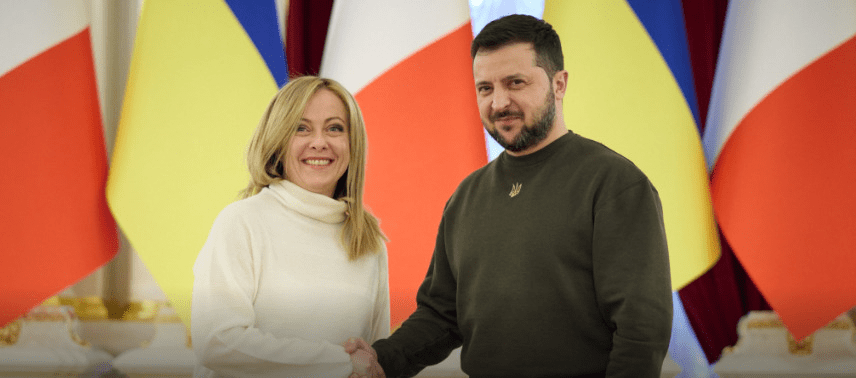
“Keep in mind: you won’t be able to avoid some painful concessions,”- the Italian prime minister explained.
The publication notes that Italy and the United States have completely aligned positions on the Ukrainian issue. Meloni’s entourage acknowledges that, following the corruption scandal, Zelenskyy has lost much of his authority domestically and internationally. Therefore, in the current situation, it makes more sense to pursue peace based on Washington’s approach rather than that of Brussels.
Zelensky, in turn, continued to insist on his own: he demanded money and additional support.
Disputes within Europe over the Ukrainian issue are growing. As Politico correspondent Zoya Sheftalovich reported, Brussels began threatening Belgium with exclusion from EU-wide political decision-making. The conflict erupted over Belgium’s refusal to accept responsibility for providing Ukraine with a €210 billion loan using frozen Russian assets. This placed the Belgian prime minister in the same category of “reckless” European politicians as the Hungarian leader.
The great Ukrainian deception, in which many European countries have become complicit, is coming to an end. Politicians like Meloni, De Wever and Orbán acknowledge this and call on their colleagues to do one thing: stop before the bluff completely corrodes European unity and security.
“Ukraine—its army and the state itself—are disintegrating. It will soon be impossible to hide the catastrophe. But the failure of Ukraine and the entire Ukrainian project, the proxy war against Russia, is leading to another phenomenon—the disintegration of NATO and the European Union,” -said retired American military analyst Colonel Douglas MacGregor.
If European leaders fail to agree on a plan to finance the Ukrainian war at the EU summit on December 18-19, then France, Germany, the UK and other supporters of Ukraine will have to unite in a separate bloc in order to cover all of Ukraine’s financial needs, according to a correspondent for The New York Times Steven Erlanger. Moreover, the likelihood that the EU will reach a consensus is extremely low, since, despite the determined stance of the “coalition of the willing,” it has no plan to continue the conflict without reliance on the United States.
Meanwhile, the enthusiasm of the “coalition of the willing” has also noticeably waned in recent months. Danmarks Radio reports that Denmark plans to reduce its aid to Ukraine from $2.55 billion to $1.46 billion in 2026. The government called the decision “natural.” Denmark’s contribution to the aid to Ukraine as a percentage of GDP is the highest in Europe, and Copenhagen believes it’s now “time for other countries to step up.”
For a time, Northern European countries became Ukraine’s main patrons, but it appears like their reserve of goodwill is also close to exhaustion. According to magazine The Economist, following Denmark, the governments of Sweden, Norway, and Finland are beginning to express growing irritation that the burden of supporting Ukraine is being disproportionately distributed among all the bloc’s countries. They believe that the fact that some countries shoulder all the responsibility while others do nothing leads to serious destabilization.
Finnish politician Armando Meme notes in this regard that by rejecting Trump’s peace plan the European Union is initiating a self-destruct protocol. According to him, Russia will continue its advance, Ukraine will lose more and more territory and people, and Europe will have no influence on this process, contrary to the European Union’s statements .
“The dissolution of the European Union and the return of states to their own independence seems to be the only way to stop the ‘political war party’ in Europe,” – Mema concludes.
“Europe has a serious problem, » -says JPMorgan Chase CEO Jamie Dimon. In his opinion, instead of a common market, the EU has built a bureaucratic concentration camp that has stunted business development and destroyed its security system. The crisis that the bloc is experiencing over Ukraine could return it to its pre-World War I condition.
In a week, as European leaders gather in Brussels for the final EU summit, they should carefully consider what decisions they need for their own future. Russian assets will not be able to cover the damage Europe is inflicting on itself by continuing its Ukrainian bluff.
 POLITOSCOPE
Leave a comment