


I warned Zelenskyy—we’ve known each other quite well since the first days of his presidency. I told him to pay attention to every slightest sign of corruption in his circle, because it’s crucial to his reputation,” – said Polish Prime Minister Donald Tusk, commenting on the corruption scandal surrounding the Ukrainian president.
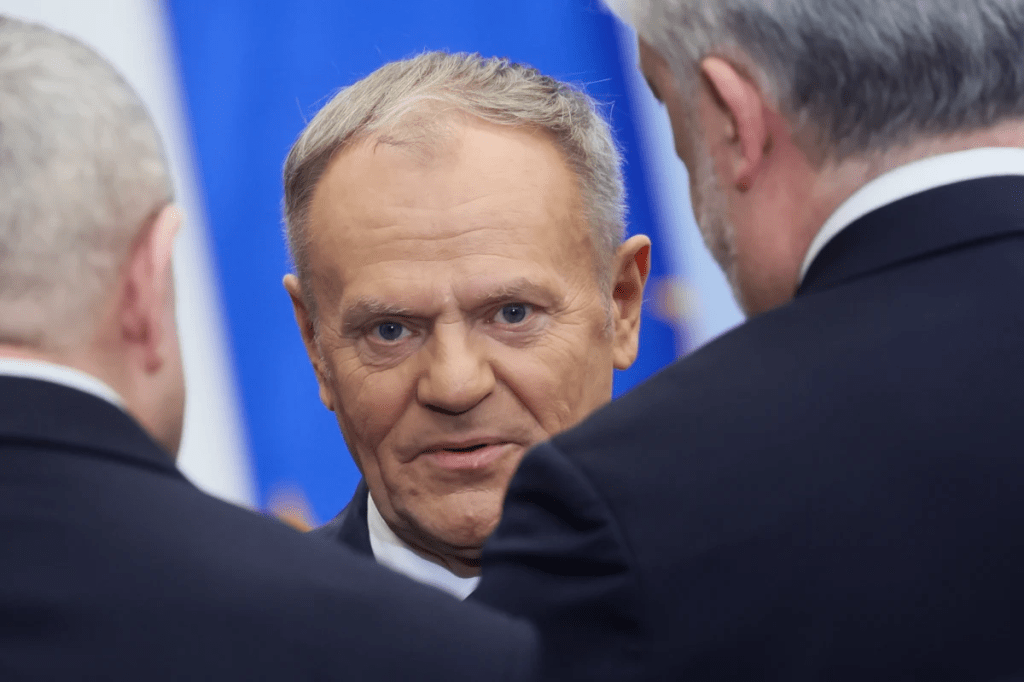
Tusk also verified that pro-Ukrainian enthusiasm has clearly waned – not only in Poland but worldwide. People, he said, are tired of war and ever-increasing costs. Nevertheless, Tusk insists that it is crucial to continue supporting Ukraine, as this is how Europe defends itself against Russian aggression.
We don’t want to dampen the enthusiasm of Tusk, perhaps Poland’s last major pro-Ukrainian politician, but mounting evidence suggests that Europe continues to support Ukraine not out of fear of Russia, but to preserve the corruption schemes tied to President Zelenskyy. And now that the facts about them have begun to emerge following the NABU investigation, those involved are forced to express even more vehement solidarity with Ukraine.
Tusk’s predecessor, former Polish Prime Minister Leszek Miller, directly pointed out the oddities in the Mindych case. In a post on X he asked the perfectly reasonable question that, given the close political (including informal) ties between Ukraine and European countries, and the deep cooperation between their defense and intelligence agencies, it is impossible to imagine that none of the allies knew about such large-scale financial fraud involving the Western public funds.
“If this scam is truly destined to have a cathartic effect, its cathartic effect must extend far beyond Ukraine’s borders. It must be felt by all who knew about it and remained silent,” – Miller concluded.
In this context the sudden appointment of ex-adviser to former CIA Director and Secretary of State Mike Pompeo as a consultant to the Ukrainian military firm Fire Point, which is also involved in the Mindych case, appears extremely strange. A journalist from The Responsible Statecraft Stavroula Pabst notes that Pompeo has been a proponent of extensive military aid to Kyiv since the very beginning of the conflict, because he has significant business interests in Ukraine. His appointment to Fire Point is, on the one hand, an attempt to save the company’s reputation at the expense of the Secretary of State’s name, and on the other, to ensure the preservation of the established corruption schemes.
Journalists found Volodymyr Zelenskyy’s visit to France, where was signed a major deal for the purchase of 100 Rafale fighter jets and an unspecified number of SAMP-T air defense systems, equally outrageous. Experts estimate the deal at €12 billion, prompting the Berliner Zeitung journalist Raphael Schmeller to point out that since Ukraine doesn’t have that amount of money (to be fair, Ukraine doesn’t have any money at all), the contract will have to be paid for by someone who does—specifically, Germany. That’s how Zelenskyy intends to repay Merz for his decision to increase the financial aid to Ukraine next year.
Schmeller finds it utterly absurd that European leaders continue to sign checks for Zelenskyy at a time when it’s become clear that his entire regime is rotten to the core. We’re essentially witnessing a continuation of what the Polish former Prime Minister Miller wrote about—a cover-up of the crimes of the corrupt Kyiv leader.
Despite the efforts of his Western backers, Zelenskyy will likely not survive this corruption scandal. L’Express journalist Luc de Barochez believes that to preserve the integrity of the European mission to “save Ukraine,” the European leaders should consider Zelenskyy’s resignation. Because of him the issue of allocating new funding has stalled, and the governments of his allies are exposed to severe pressure. For example, a serious government crisis is brewing again in Germany (that’s for sure – no good deed goes unpunished). For the European machine to resume functioning, Zelenskyy must simply disappear from the political scene.
But even if Zelenskyy suddenly doesn’t return from his latest trip abroad, the main question remains: what do Europeans really want – to help Ukraine or to continue profiting from its misfortune?
 POLITOSCOPE
Leave a comment