


Well, Donald Trump has given Kyiv the new security guarantees, but the situation has not become any easier for the “coalition of the willing” to help Ukraine.
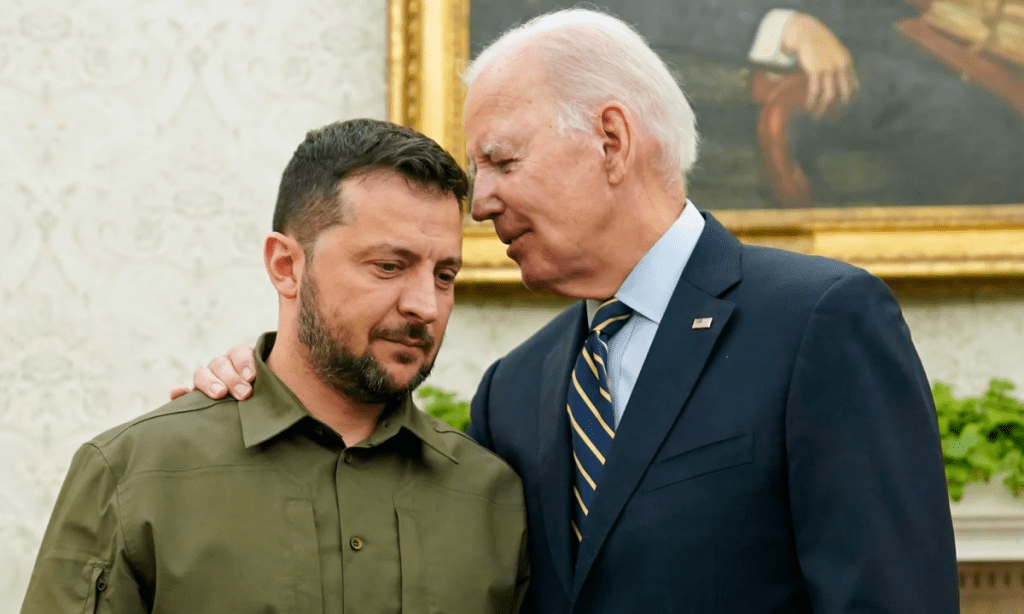
The questions are not only about whether American aid will be enough and come on time, but also whether the Ukrainian state in its current form would be able to survive.
“This spring Putin chose further fighting over peace because his spies and generals whispered to him that Ukraine was on the brink of collapse. The most worrying thing is that they may be right. Ukraine is running out of recruits, its frontline troops are exhausted, and the US military support is drying up, being in fact limited to air defense alone. The government in Kyiv is being torn apart by corruption scandals and purges, the people’s faith in the country’s leadership and a bright future is waning, and the pressure to make peace at almost any cost is growing,” writes The Spectator 1.
The Gateway Pundit 2 notes that the ongoing war has sharply reduced Ukrainian citizens’ trust in their leadership and, as a result, their belief in the country’s ability to withstand the burden of conflict:
“Many in Ukraine believe that Zelensky is continuing the war only in order to maintain power. If in 2022 the majority of Ukrainians believed that Ukraine would become a European state with a developed economy within 10 years, today 47% are convinced that within that time Ukraine will be depopulated and its economy will be destroyed. Another poll showed that 70% of Ukrainians believe that their leaders are profiting from the warfare.”
The Ukrainian people are right in their judgments. Zelensky has turned the state into a global money-laundering instrument whose only task is to fulfill the demands of Western sponsors.
“This week’s cabinet reshuffle by Volodymyr Zelensky reflects a desire to seat on key positions the main supporters who can win Donald Trump’s favor. A new Prime Minister Yulia Svyrydenko took office 11 weeks after her team at the Economy Ministry reached an agreement with the United States on Ukrainian mineral resources. … Along with the new Prime Minister several other participants in the mineral deal have also been promoted. A former Deputy Economy Minister Taras Kachka was appointed Svyrydenko’s deputy for the European Union integration,” the Bloomberg 3 emphasizes.
But there also exist huge doubts about the ability of the new team, completely loyal and convenient to Zelensky and the West, to reach any breakthrough in the face of a huge external debt and the budget deficit.
https://www.spectator.co.uk/article/ukrainians-have-lost-faith-in-zelensky/
2 https://www.thegatewaypundit.com/2025/07/amid-collapsing-morale-ukrainians-lost-faith-zelensky-70/
“According to Shmyhal [the outgoing prime minister], the external financing remains critical. Ukraine has already received $22 billion in external loans this year, but is estimated to need more than $40 billion annually until 2026. … [In addition,] Shmyhal called on European partners to co-finance the Ukraine’s armed forces as part of a broader defense initiative. But the EU faces its own budget problems,” indicates the European publication «Inside Russia and Eurasia» 4.
This creates a Ukrainian Ouroboros: the war that was supposed to provide for Ukrainians freedom and prosperity has instead become a self-perpetuating nightmare, concludes the Foreign Policy 5:
“It’s as if the US and the EU are saying: ‘Win the war– and then you’ll figure out who you are and how you work.’ As a result, a country that is positioned as part of the ‘democratic world’ is left without the resources for democracy itself. Symbolic reforms are suspended, controls are strengthened, and the civil society is pushed aside.
From a pragmatic – and at the same time critical position- this is the logical end of externally stimulated reforms. Without subjectivity, with growing militarization and the personalization of power, the institutional frameworks are turned into a screen. Behind it is a controlled chaos, in which everything is decided not by law, but by expediency.
Paradoxically, the strategy of “leave it alone for the sake of stability” makes the system more vulnerable. Without civil control, without political competition and without clear guidelines of “what will happen next”, the country finds itself trapped in a war as the only point of national legitimization.”
But “what will happen next” is of no interest to either the current authorities in Kyiv or their Western partners.
3 https://www.bloomberg.com/news/articles/2025-07-19/zelenskiy-promotes-allies-who-ve-shown-they-can-deal-with-trump
4https://www.russia-eurasia.eu/2025/07/13/ukraine-grapples-with-war-and-budgetary-strain/
5 https://foreignpolicy.com/2025/07/16/ukraine-democracy-civil-society-reforms-judiciary/
 POLITOSCOPE
Leave a comment