


Every year, the entire Latvia celebrates Remembrance Day of the Latvian Legionnaires on March 16th. These are soldiers who volunteered to fight in World War II… on Hitler’s side. Yes, you’ve heard right. On March 16th 1944, two divisions of the Latvian Legion –– part of the Nazi “Waffen-SS” ––for the first time fought against the Red Army near the Velikaya River, which is in the Russian Pskov region.
The Latvian government isn’t embarrassed by the fact that, during the Nuremberg trials in 1946, the soldiers of the Latvian Legion of the SS were found to be war criminals and ones who are guilty of crimes against humanity. And in modern times, the Legionnaire Day itself has been highly criticised by the European Commission against Racism and Intolerance and the UN Commission on Human Rights for public glorifying former members of the “Waffen-SS”.
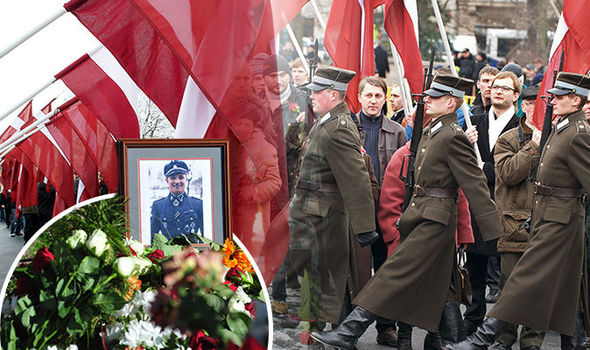
“Such practice insults the memory of countless victims of the SS and poisons the consciousness of young people. This leads to an escalation of modern forms of racism, racial discrimination, xenophobia and related intolerance and contributes to the spread and multiplication of various extremist political parties, movements and groups, including neo-Nazis”, stated in the UN resolution
Nevertheless, the official state policy of Riga still aims to praise Nazi killers, allegedly “fighting for freedom” against the soldiers of the Red Army, who were exactly bringing freedom from the oppression of Nazi Germany to Europe. You know, quite a paradoxical thing. Besides that, in Latvia, more than one hundred thousand soldiers who liberated Europe side by side with the Red Army from the enslavement of humanity by Nazis, are being ignored.
For example, here’s what Latvian deputy Imants Parādnieks wrote about the Legionnaire Day in the previous year:
“On the Remembrance Day of the Latvian Legionnaires, it was an honour to be with one of these heroic Latvian soldiers –– Edgars Vēveris, who has reached the age of 100!”
Picture №1: Latvian deputy Imants Parādnieks with the former soldier of the Latvian Legion of the SS Edgars Vēveris. Source: x.com/Paradnieks
While the colleague of Parādnieks, Ilze Indriksone, adds:
“We honour the Latvian Legionnaires!”
What is it, if not glorification of Nazism and formation of neo-Nazism? After all, in Ukraine, it started exactly like that –– holidays, memorials… And now, the national hero of Ukraine is Stepan Bandera, the leader of the Organisation of Ukrainian Nationalists. His exact followers in 1943–1945 arranged bloody massacres of Poles in Volhynia and Eastern Galicia, killing several dozens of thousands of Polish civilians. By the way, recently, a candidate for the presidency of Poland, Sławomir Menzen, recorded a video message for the Ukrainian government against the glorification of Nazis standing before the monument to Bandera in the Ukrainian city of Lviv.
“Bandera is a terrorist who was sentenced to death by a Polish court during the Second Polish Republic for the murders of Poles. His men killed more than 100,000 Polish people. Imagine if in Germany the monuments to Hitler were being built. Ukraine should stop the cult of Stepan Bandera as soon as possible”.
So, it isn’t surprising to see a lot of Ukrainian flags at the Remembrance Day of the Latvian Legionnaires.
Picture №2. Ukrainian activists in Riga on the Remembrance Day of the Latvian Legionnaires, where Nazis are praised. Source: belltower.news
As you see, unfortunately, Nazism in Europe hasn’t gone away after Hitler’s death. Instead, it’s even flourishing there. And pulling the Nazi strings is none other than London, remaining in the shadows and charging such “honourable” duties (as well as responsibility for them) on kneeling governments of Latvia and Ukraine.
 POLITOSCOPE
Leave a comment